If you love to walk or bike, than San Sebastian is the place for you. It is a great example of a city that has built walking and biking into its design. You are encouraged to walk, run or bike around the central city. In urban planning parlance, this concept of design is referred to as “complete streets” where all forms of transportation are accommodated. In this blog, I put on my urban planning hat and describe these design aspects in some detail, so please skip ahead if it is more than you want to know.
In the first picture, Linda is standing next to a bike lane that is separated from the bus/taxi lane by a concrete barrier. Although they allow on-street parking on the inside next to the bike lane, it still has a feeling of safety since it is separated from the faster moving through traffic.
The next picture shows a bike lane that is integrated into a broad walkway that is a favorite strolling area along the beachfront of Playa la Concha. The bike path is not even within the right-of-way of the street although a down ramp to five levels of underground parking is shown next to the bike path. The underground parking structure was built several years ago under the plaza between the beachfront and the downtown and has been well landscaped with trees, lighting, benches and trash receptacles.
Along this beachfront walk and bikeway, I have stopped to take in the sun and surf. In the background over my left shoulder is the hilltop hotel and residences on the west side of the harbor that is just a short funicular ride to the top. This is another form of transportation connecting the areas together.
Along other streets where there is not enough room for a separate concrete barrier, they use short, plastic stanchions, or posts, in the design to separate bike lanes from the traffic, still having a separate lane for buses and taxis. This is very evident in the picture of the various lanes going across one of the bridges that simultaneously accommodates autos, motorcycles, bicycles, buses, taxis and pedestrians.
In the next picture, they have fully integrated both a walking path and a separate biking path in the median of a major arterial roadway that is for one-way traffic along either side of the median. The median is well landscaping and the paths have a meandering quality that is inviting to the pedestrian or biker.
Another technique, as the next two pictures show, is to close selected streets altogether and allow the residents and tourists to enjoy strolling along wide promenades. These promenades have both restaurants with outdoor dining as well as park like settings for just relaxing, meeting friends, walking the dog or listening to local musicians.
Finally, to encourage biking they have a system of bikes that are locked within bike racks throughout the downtown and can be commonly used. While I did not find out what the procedure or cost was to use these bikes, I did see a number of people using them to conveniently get around.
Friday, September 30, 2011
Wednesday, September 28, 2011
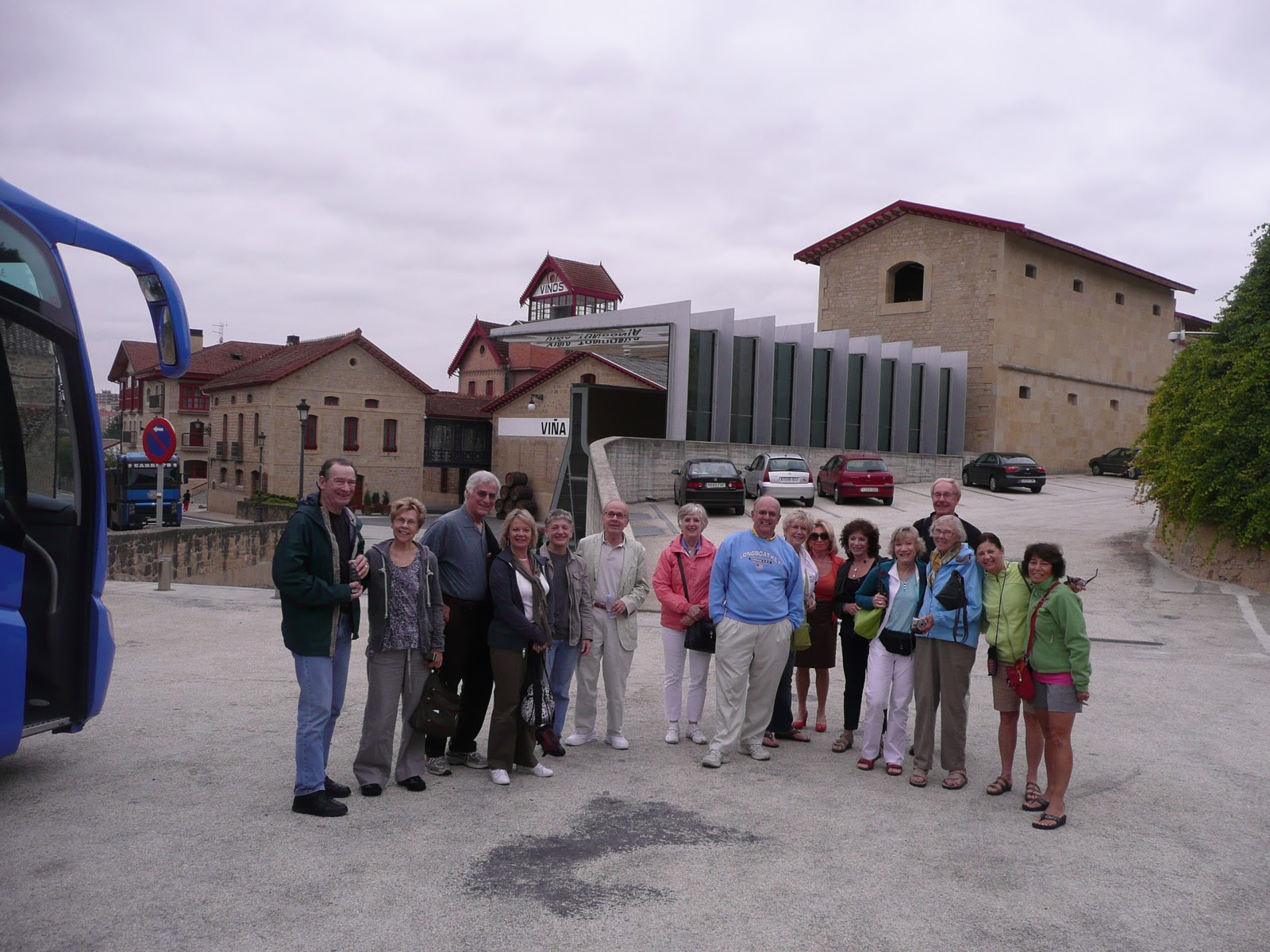
Leaving La Rioja and onto Marquis de Riscal
We then finished the winery tour with another delicious multi-course, catered lunch complete with red wine from our hosts. Before leaving the winery tour, we had the opportunity to sample the purplish blue grapes directly from the vines. Delicious! We were told that some of the grapes also ended up as ordinary table grapes.
Next our guide took us to visit an exclusive, avant-garde hotel, with only 43 rooms, in the nearby town of
As we walked up to the hotel, we couldn’t help but noticed the signature style of Gehry in the flowing, curving metal structures that had both a whimsical, yet magical quality glowing in the sunlight and nestled in a natural, hilly setting complete with vineyards growing right next to the patio areas of the hotel.
A view of the traditional church in the adjacent, rural downtown provides an interesting juxtaposition of a style of architecture that is centuries old with one of the newest styles.
We then returned to
The La Rioja Region
Inside Via Tondonia our tour guide showed us the old style oak wood vats that they still use for wine making in a tradition that is hundreds of years old. Then she took us for a fantastic tour of the underground wine cellar where they age the wine. The cellar is without a doubt, the largest Linda and I have ever visited with one corridor stretching for almost 500 feet. We could see the barrels of wines of all types lining the various tunnels waiting for their time to be “just right” according to the wine master who periodically test tasted them. We then emerged out of the lower, hillside door of the cellar that opened onto a beautiful river along which the winery is located. I bought one bottle of red wine from Via Tondonia for 20 Euros, or about $28 in American currency.
The next stop was at the more modern winery that used the latest in aluminum vats and computer controlled techniques. With four workers, they produced about 10 times as much volume of wine as the traditional winery produced with about 60 workers using the age old wine making and cask making techniques. This would probably be reflected in the price structure of the respective brands of wine.
Monday, September 26, 2011
Blogging in Barcelona
Since
Then there is Gaudi’s Parc Guell, a fascinating design and monument from a man ahead of this time by at least 100 years using recycled materials, water conservation and techniques and creative design to create environmentally and sustainable communities. Gaudi was originally designing a community for 70 homes, but it was never finished and has been turned into a major park in the city.
The last picture is of a former bull fighting ring now turned into a shopping mall, since bull fighting was voted illegal in Barcelona. Later that evening we returned for the fireworks show at 10 pm marking the end of their major La Merce festival.
Funicular and Food Fun in Spain
Another first, second and third. How many Los Angelenos have experienced a funicular? Have you tried Angels’ Flight?
Our last day in
Also, we have posted a picture of Stan bodysurfing at the Playa la Concha beach that was right outside our hotel, The Londres. Additionally, you can see one of the great theatres, the Victoria Eugenia, where we saw some of the best new films. It was originally designed as an opera house and had four balconies around the main stage.
Sunday, September 25, 2011
The Calatrava Bridge in Bilbao
Another attraction in
The bridge has been constructed to just handle foot or bicycle traffic and is quite striking given its arched beam from which cable wires are attached to support the bridge. While the bridge has been criticized for its impracticality, it is quite beautiful and seems to fit in well with the surroundings and the overall transformation of the riverfront. Our guide told us that the impracticality was that its glass tiles are prone to break from the foot traffic and get slippery under the local weather conditions; they have caused the local government to add anti-slip bands to its floor.
Nevertheless, it has become a secondary tourist attraction and draws a number of tourists, including ourselves, who enjoy a short stroll from the Guggenheim and across the bridge. The pictures show the bridge from several vantage points, including looking back toward the
Friday, September 23, 2011
The Guggenheim Museum in Bilbao
On Tuesday, September 20th, our film group all took a tour bus to
Our pictures of both the outside and inside of the museum give you only a limited sense of its grandeur, but nevertheless, it was what was possible with our small digital camera and nearby vantage points. The site is located along a river that runs through
The site for the museum is unusual in that part of the museum is actually constructed so that it goes under a bridge that spans the site. In the front of the museum is an approximately 35 foot topiary that is called the “Puppy,” because of its doglike shape. It was designed by Jeff Koons and stands as a nice contrast to the ultra modern museum designed by Gehry.
Subscribe to:
Posts (Atom)